Pool progression after Achilles rupture works best when it is progressed, not rushed. Swimming and water exercise are often described as “safe,” but the tendon is still being loaded, just differently.
A structured pool plan helps reintroduce movement and cardiovascular work while protecting the healing tendon.
Contents
- Key takeaways
- Why pool exercise needs progression
- A typical pool progression plan
- How to progress without rushing
- What to avoid during pool progression
- What this means for your recovery
- Frequently asked questions
- References
Key takeaways
- Pool exercise is low impact, but low impact does not mean no load.
- A common progression is pool walking -> gentle swimming -> longer swims or pool running.
- Week ranges are typical guideposts, not automatic clearance.
- Progression should depend on pain, swelling, stiffness, gait quality, wound healing, and clinician advice.
- Do not add duration, intensity, kicking force, and frequency all at once.
Why pool exercise needs progression
Water supports body weight, which can reduce tendon load compared with land-based exercise. That makes pool work useful during the transition back to fitness.
But the pool is not magic. Walking in water still requires balance and controlled steps. Swimming still uses the calf through kicking. Pool running can become repetitive and intense quickly. Wet decks and pool steps add a fall risk.
The goal is controlled loading: enough to rebuild confidence and fitness, not so much that the tendon flares.
A typical pool progression plan
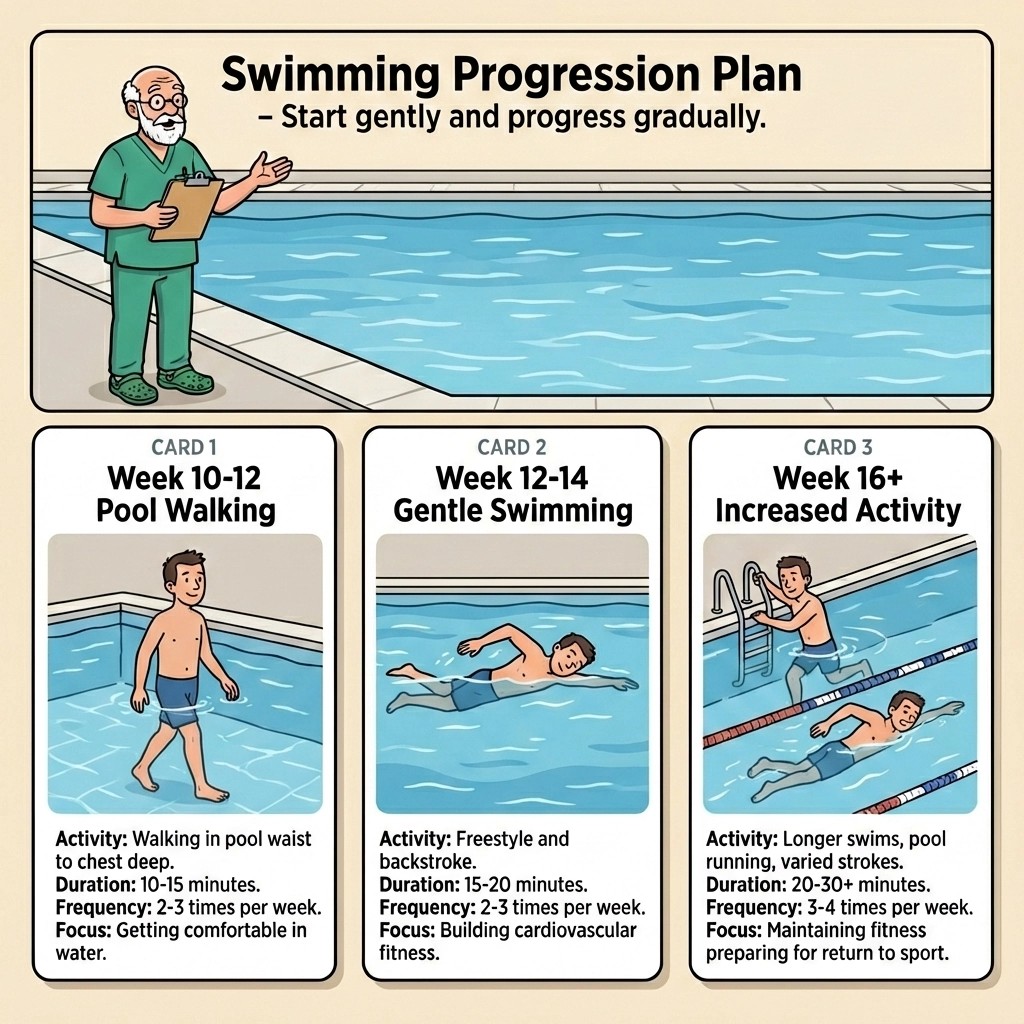
The week ranges below are a typical framework, not a rule. Your own plan should be adjusted for surgery versus non-surgical treatment, wound healing, tendon gap, pain, swelling, gait quality, and your physiotherapist’s assessment.
| Stage | Activity | Dose | Focus |
|---|---|---|---|
| Weeks 10-12: pool walking | Walk in waist-to-chest-deep water | 10-15 minutes, 2-3 times per week | Confidence, control, and low-load movement |
| Weeks 12-14: gentle swimming | Easy freestyle or backstroke | 15-20 minutes, 2-3 times per week | Light cardio without hard push-offs or aggressive kicking |
| Week 16+: increased activity | Longer swims, cautious pool running, gradual variation | 20-30+ minutes, 3-4 times per week if tolerated | Endurance and preparation for higher-level activity |
If week 12 swimming leaves you swollen or limping the next morning, you are not “behind”; the dose was too high for the tendon that day. Return to pool walking or shorter easy swims and build again.
How to progress without rushing
Use a simple progression rule: change one variable at a time.
You can adjust:
- Duration
- Frequency
- Swimming speed
- Kicking effort
- Stroke choice
- Pool depth
- Pool running or variation
Do not increase all of them together. A small increase that your tendon tolerates repeatedly is better than one impressive session followed by a flare.
Before moving to the next stage, ask:
- Was pain low during the session?
- Was swelling the same or better the next day?
- Was morning stiffness acceptable?
- Did walking quality stay the same?
- Did heel raises or physio exercises feel worse afterward?
If the answer is no, stay at the current level or step back.
What to avoid during pool progression
The biggest mistake is confusing water support with unlimited tendon capacity.
Avoid:
- Hard push-offs from the wall
- Flip turns
- Diving
- Hard kicking
- Competitive sets
- Long sessions after a long workday or heavy walking day
- Pool running before calf control and walking quality are stable
For the safety checklist, read swimming after Achilles rupture: what to avoid.
What this means for your recovery
Pool progression is a bridge, not a shortcut. It can help rebuild fitness while land-based running and sport are still too demanding, but it still needs the same rehab logic: control first, then duration, then intensity.
For wider cardio planning, see cardio after Achilles rupture. For stage-based guidance, see the Achilles rupture rehabilitation FAQ and Achilles recovery course.
Seek urgent medical review if you feel a sudden pop, sharp pain, loss of push-off, a new gap in the tendon area, or a sudden major change in walking. If swelling climbs up the whole leg, especially with calf pain, breathlessness, or chest pain, seek urgent review for a possible blood clot.
Frequently asked questions
What is a typical pool progression after Achilles rupture?
A common pattern is pool walking around weeks 10-12 once cleared, gentle swimming around weeks 12-14, then longer swims or carefully introduced pool running from roughly week 16 onward if symptoms and control are stable.
When can I start pool walking after Achilles rupture?
Pool walking is often considered after boot removal and clinician clearance, commonly around the week 10-12 phase in many pathways. Wound healing, balance, and safe pool entry matter as much as the week number.
When can I start gentle swimming after Achilles rupture?
Gentle freestyle or backstroke may be introduced after pool walking is tolerated and your clinician clears it. Many patients start with short 15-20 minute easy sessions rather than hard training.
When can I try pool running after Achilles rupture?
Pool running usually comes later because it is repetitive and can become intense quickly. It should wait until walking quality, calf control, and symptom response are stable.
How do I know if my pool progression is too fast?
Delayed swelling, more pain, worse morning stiffness, a new limp, or reduced push-off the next day usually means the pool load is ahead of your tendon capacity.
References
- Banff Sport Medicine. Achilles Tendon Rupture Rehabilitation Protocol.
- Royal Berkshire NHS Foundation Trust. Achilles Tendon Rupture: Conservative Management.
- Zellers JA, Carmont MR, Gravare Silbernagel K. Defining Components of Early Functional Rehabilitation for Acute Achilles Tendon Rupture: A Systematic Review. Orthopaedic Journal of Sports Medicine. 2019.
Primary source: Banff Sport Medicine. Achilles Tendon Rupture Rehabilitation Protocol
